


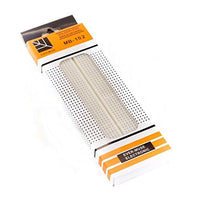
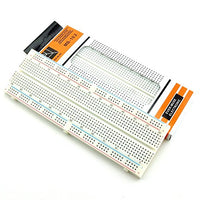


MB102 830 Points Solderless Prototype PCB Breadboard
Rs. 63.00
(Incl. GST)
QUICK OVERVIEW
- MB102 830 Points Solderless Prototype PCB Breadboard The MB102 830 Points Solderless Prototype PCB Breadboard is a r...
- Widely used in electronics laboratories, educational institutions, embedded system development, and DIY electronics p...
- Its solderless construction allows electronic components and jumper wires to be inserted and removed repeatedly, maki...
- Users can quickly modify circuit layouts, replace components, troubleshoot wiring issues, and experiment with differe...
🚚 Item will be delivered on or before

MB102 830 Points Solderless Prototype PCB Breadboard
The MB102 830 Points Solderless Prototype PCB Breadboard is a reusable and versatile electronic prototyping platform designed for building, testing, and modifying circuits quickly without the need for soldering. Widely used in electronics laboratories, educational institutions, embedded system development, and DIY electronics projects, this breadboard provides a convenient and organized method for assembling experimental circuits and prototype designs.
Featuring a total of 830 tie points, the MB102 breadboard offers ample space for creating small to medium-sized electronic circuits involving microcontrollers, sensors, integrated circuits, communication modules, and power management systems. Its solderless construction allows electronic components and jumper wires to be inserted and removed repeatedly, making it highly suitable for rapid prototyping, testing, debugging, and educational experimentation.
The breadboard is specifically designed to simplify electronics development by eliminating the need for permanent soldered connections during the design and testing phase. Users can quickly modify circuit layouts, replace components, troubleshoot wiring issues, and experiment with different configurations without damaging components or requiring specialized soldering equipment.
The MB102 breadboard is fully compatible with a wide range of electronic components and development platforms including Arduino Uno R3, Arduino Nano Board V3, Arduino UNO R3 (CH340G), ESP32 development boards, NodeMCU modules, and Raspberry Pi 4 Model B systems. This compatibility makes it one of the most commonly used prototyping tools for embedded electronics and IoT development.
The breadboard supports standard 2.54 mm pitch electronic components, which is the industry-standard spacing used for most DIP integrated circuits, transistors, resistors, capacitors, LEDs, switches, and jumper wires. This standardized spacing ensures broad compatibility with commonly available electronic parts and modules.
Internally, the breadboard contains interconnected metal spring clips positioned beneath the plastic surface. These conductive clips create temporary electrical connections when component leads or jumper wires are inserted into the holes. The internal connection structure allows users to easily create circuit paths without soldering.
The 830 tie points are divided into multiple sections to support organized circuit assembly. The central terminal strips are designed for mounting DIP (Dual Inline Package) integrated circuits and signal wiring, while the side power rails simplify power distribution across the board. This layout allows efficient circuit organization and reduces wiring complexity during development.
The center gap running along the breadboard is specifically designed to accommodate DIP IC packages such as microcontrollers, logic ICs, driver chips, and operational amplifiers. Components can straddle the center gap while maintaining independent electrical connections on each side, simplifying integrated circuit prototyping.
Clearly marked rows and columns improve readability and circuit organization. The printed numbering and lettering system helps users identify connection points accurately, reducing wiring errors and simplifying troubleshooting. This organized layout is especially beneficial for beginners learning electronics and for complex circuit development involving multiple components.
The MB102 breadboard is constructed using durable ABS plastic material that provides good mechanical strength, electrical insulation, and long operational life. The high-quality internal spring clips maintain reliable electrical contact even after repeated insertion and removal of components, ensuring stable circuit performance during experimentation.
Its lightweight and compact design makes the breadboard portable and easy to integrate into workbenches, educational kits, laboratory setups, and prototype systems. Many versions also include an adhesive backing that allows secure mounting onto flat surfaces, project enclosures, or development platforms.
The solderless nature of the breadboard offers several important advantages during electronics development. Since components are not permanently attached, users can easily reconfigure circuits, test multiple designs, and experiment with new ideas without damaging hardware. This flexibility significantly reduces development time and cost during prototype creation.
The MB102 breadboard is widely used in educational environments where students learn electronics fundamentals, circuit design, embedded programming, sensor interfacing, and microcontroller applications. Beginners can safely experiment with electronic circuits without requiring advanced soldering skills or expensive PCB fabrication.
In embedded systems and IoT projects, the breadboard is frequently used for testing sensors, displays, communication modules, actuators, and power circuits before designing permanent PCBs. Developers can quickly validate hardware functionality and software integration during the early stages of product development.
Robotics enthusiasts commonly use the breadboard for prototyping motor control circuits, sensor interfaces, servo controllers, and wireless communication systems. Its reusable structure allows rapid iteration during robotic system design and testing.
The MB102 breadboard is also highly valuable for DIY electronics and hobby projects. Users can build circuits involving LED blinking systems, automation devices, smart home controllers, alarm systems, data logging systems, environmental monitoring systems, and many other embedded applications.
The breadboard supports both low-voltage analog and digital circuits, making it suitable for a wide variety of electronic experiments and prototype systems. Common components used with the board include:
-
Resistors and capacitors
-
LEDs and switches
-
Transistors and diodes
-
Integrated circuits (ICs)
-
Sensors and modules
-
Microcontrollers and development boards
-
Relays and communication devices
-
Displays and indicator circuits
Because the breadboard does not require soldering, it significantly simplifies troubleshooting and component replacement. Faulty components can be quickly removed and replaced without damaging the circuit or requiring desoldering tools.
The MB102 breadboard is commonly applied in:
-
Arduino prototyping projects
-
Raspberry Pi interfacing circuits
-
Embedded systems development
-
Robotics and automation systems
-
Sensor testing applications
-
Educational electronics laboratories
-
DIY electronics experimentation
-
IoT prototype development
-
Circuit debugging and testing
-
STEM learning activities
-
Communication module interfacing
-
Power supply testing circuits
Another major advantage of the MB102 breadboard is its cost-effectiveness and reusability. A single breadboard can be reused for countless projects and experiments, making it an economical solution for students, laboratories, and development environments.
The breadboard is also compatible with standard jumper wires such as male-to-male, male-to-female, and female-to-female jumper cables, allowing flexible and organized circuit connections between components and development boards.
Although highly versatile, breadboards are generally intended for temporary circuits and low-power applications. For permanent installations or high-current circuits, custom PCBs or soldered prototyping boards are typically recommended.
The MB102 breadboard’s popularity is supported by extensive online tutorials, educational resources, and project examples available for beginners and advanced developers alike. Its standardized layout makes it one of the easiest prototyping tools to learn and use in modern electronics development.
Overall, the MB102 830 Points Solderless Prototype PCB Breadboard is a practical, reusable, and highly effective prototyping solution designed for electronics learning, circuit testing, embedded systems development, and experimental engineering applications. Its 830 tie-point layout, solderless operation, durable construction, breadboard-friendly design, and compatibility with standard electronic components make it an essential tool for students, hobbyists, educators, and professional developers working on Arduino, Raspberry Pi, robotics, automation, and IoT projects. Whether used for educational experiments or advanced prototype development, the MB102 breadboard provides a reliable and convenient platform for rapid electronic circuit creation and testing.
| Vendor | electro robo store |
|---|---|
| Type | MB102 830 Points Solderless Prototype PCB Breadboard |
| Sku | MT0551 |
| Barcode | true |
