


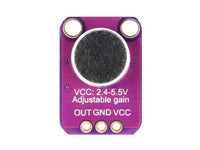

MAX4466 Electret Microphone Amplifier with Adjustable Gain
Rs. 107.00
(Incl. GST)
QUICK OVERVIEW
- MAX4466 Electret Microphone Amplifier with Adjustable Gain The MAX4466 Electret Microphone Amplifier with Adjustable ...
- Built around the low-noise MAX4466 operational amplifier, this module provides clean and amplified audio output from ...
- Its compact design, adjustable gain capability, and low power consumption make it highly suitable for portable electr...
- The amplifier boosts weak microphone signals while maintaining low distortion and minimal background noise, resulting...
🚚 Item will be delivered on or before

MAX4466 Electret Microphone Amplifier with Adjustable Gain
The MAX4466 Electret Microphone Amplifier with Adjustable Gain is a compact, high-sensitivity audio input module designed for sound detection, voice capture, and analog audio processing applications in embedded systems and electronics projects. Built around the low-noise MAX4466 operational amplifier, this module provides clean and amplified audio output from an onboard electret condenser microphone, making it ideal for voice recognition systems, audio recording, sound-reactive projects, robotics, IoT devices, and microcontroller-based audio applications.
The module combines a sensitive electret microphone with a precision audio amplifier circuit to capture weak sound signals and convert them into stable analog voltage outputs suitable for processing by microcontrollers, ADCs, and digital signal processing systems. Its compact design, adjustable gain capability, and low power consumption make it highly suitable for portable electronics, educational projects, and embedded audio systems.
At the core of the module is the MAX4466 operational amplifier, a low-noise and rail-to-rail op-amp specifically designed for microphone amplification and audio signal conditioning. The amplifier boosts weak microphone signals while maintaining low distortion and minimal background noise, resulting in cleaner and more accurate audio capture.
The onboard electret condenser microphone detects sound waves from the surrounding environment and converts them into small electrical signals. These signals are then amplified by the MAX4466 amplifier circuit to produce a stronger analog output that can be read and processed by electronic systems.
One of the major features of this module is its adjustable gain control capability. Using the onboard trimmer potentiometer, users can manually adjust the amplifier gain from approximately 25x to 125x depending on application requirements. This adjustable sensitivity allows the module to operate effectively in both quiet and noisy environments.
Lower gain settings are suitable for loud audio environments where excessive amplification may cause distortion, while higher gain settings improve sensitivity for detecting weak or distant sounds. This flexibility makes the module highly adaptable for different audio processing applications.
The MAX4466 module operates within a voltage range of approximately 2.4V to 5.5V DC, making it compatible with most low-voltage embedded systems and development platforms. It can be directly powered using 3.3V or 5V microcontroller power supplies without requiring additional voltage conversion circuits.
The module provides a rail-to-rail analog output signal, meaning the output voltage can swing close to the supply voltage range. This improves dynamic range and allows microcontrollers to capture more detailed audio information during analog-to-digital conversion.
The simple three-pin interface generally includes:
-
VCC (Power Supply)
-
GND (Ground)
-
OUT (Analog Audio Output)
This straightforward interface enables easy connection to analog input pins of microcontrollers and embedded systems.
The module is highly compatible with popular development platforms such as Arduino Uno R3, Arduino Nano Board V3, ESP32 controllers, NodeMCU systems, STM32 development boards, and Raspberry Pi 4 Model B computers when used with analog input or external ADC interfaces.
Because the output is analog, developers can perform various forms of audio analysis and processing, including:
-
Sound level monitoring
-
Voice detection
-
FFT (Fast Fourier Transform) analysis
-
Audio spectrum visualization
-
Speech processing
-
Sound-triggered automation
-
Environmental noise monitoring
The module is widely used in voice recognition and voice-controlled systems because it provides stable and amplified microphone signals suitable for speech detection algorithms and intelligent audio processing applications.
In Arduino and ESP32 projects, the module is commonly used for sound-reactive LEDs, clap switches, voice-controlled robots, smart automation systems, and interactive electronics. The adjustable gain feature allows developers to fine-tune microphone sensitivity for optimal performance.
The MAX4466 microphone amplifier is also highly suitable for robotics applications where audio sensing is required. Robots can use the module for voice command systems, sound localization experiments, environmental awareness, and interactive communication functions.
In IoT and smart home systems, the module can support audio-triggered automation and monitoring applications. It can detect sound events, monitor environmental noise levels, or act as an audio input device for connected systems.
Educational institutions and STEM programs frequently use the module for teaching analog electronics, audio amplification, signal conditioning, embedded programming, and sound processing concepts. Students can gain practical experience with microphone interfacing and analog signal analysis using beginner-friendly microcontroller platforms.
The compact PCB design allows easy integration into portable electronics, wearable systems, compact robotics, and embedded devices. Its low power consumption also makes it suitable for battery-operated projects and energy-efficient systems.
Typical applications of the MAX4466 Electret Microphone Amplifier Module include:
-
Voice recognition systems
-
Sound detection circuits
-
Audio recording systems
-
FFT audio analysis projects
-
Sound-reactive LED systems
-
Clap-controlled automation
-
Robotics and interactive systems
-
IoT audio monitoring devices
-
Environmental sound sensing
-
Smart assistant projects
-
DIY electronics projects
-
Educational audio experiments
One of the key advantages of the MAX4466 module is its manual gain adjustment capability. Unlike fixed-gain microphone modules, users can optimize sensitivity precisely for their environment and application, improving flexibility and performance.
The low-noise characteristics of the MAX4466 operational amplifier help minimize unwanted electrical noise and improve signal clarity, making the module suitable for more accurate sound analysis and voice processing applications.
The module also benefits from wide community support and extensive online documentation. Numerous Arduino examples, ESP32 audio projects, tutorials, and software libraries are available for beginners and advanced developers alike.
Proper power supply filtering and grounding practices can further improve audio quality and reduce electrical interference during operation. Shielded wiring may also help minimize external noise in sensitive audio systems.
Another important advantage of the MAX4466 module is its simplicity. Unlike digital microphone systems requiring complex communication protocols, this analog module can be directly connected to standard analog input pins for rapid prototyping and easy integration.
Overall, the MAX4466 Electret Microphone Amplifier with Adjustable Gain is a reliable, compact, and highly flexible audio input solution designed for embedded audio processing, voice detection, robotics, IoT systems, and educational electronics applications. Its low-noise MAX4466 amplifier, adjustable gain control, sensitive electret microphone, rail-to-rail analog output, and compatibility with popular microcontroller platforms make it an excellent choice for students, hobbyists, educators, and developers building interactive sound-based electronic systems. Whether used in voice recognition devices, sound-reactive projects, automation systems, or audio analysis applications, this module delivers clear sound capture, stable amplification, and efficient analog audio performance in a compact and user-friendly design.
| Vendor | Electro Robo Store |
|---|---|
| Type | MAX4466 Electret Microphone Amplifier with Adjustable Gain |
| Sku | MT0389-1 |
| Barcode | true |
