


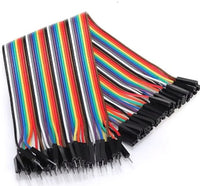
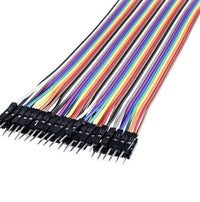
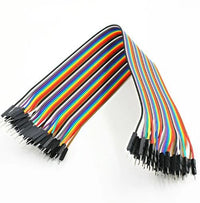


Male to Female Jumper Wires (20cm) 40pcs
Rs. 50.00
QUICK OVERVIEW
- Male to Female Jumper Wires (20 cm, 40 PCS) The Male to Female Jumper Wires (20 cm, 40 PCS) are essential electronic...
- These jumper wires are widely used in electronics experimentation, embedded system development, robotics, IoT applica...
- Their simple plug-and-play design allows users to build, modify, and test circuits efficiently without requiring sold...
- This Male-to-Female configuration enables seamless interfacing between male header pins and female connector ports co...
🚚 Item will be delivered on or before

Male to Female Jumper Wires (20 cm, 40 PCS)
The Male to Female Jumper Wires (20 cm, 40 PCS) are essential electronic prototyping accessories designed for creating quick, reliable, and solderless electrical connections between development boards, sensors, modules, breadboards, and various electronic components. These jumper wires are widely used in electronics experimentation, embedded system development, robotics, IoT applications, automation projects, educational laboratories, and DIY electronics. Their simple plug-and-play design allows users to build, modify, and test circuits efficiently without requiring soldering, making them an indispensable tool for students, hobbyists, engineers, and professional developers.
Each jumper wire features a male connector pin on one end and a female socket connector on the opposite end. This Male-to-Female configuration enables seamless interfacing between male header pins and female connector ports commonly found on microcontroller boards, sensor modules, relay boards, communication modules, and expansion shields. The design provides flexibility for connecting devices with different connector types while maintaining stable electrical contact during operation.
The jumper wires are manufactured using high-quality insulated copper conductors that ensure reliable transmission of electrical power and digital or analog signals. The copper core provides low electrical resistance, stable conductivity, and efficient signal flow, making these wires suitable for both low-power electronic circuits and data communication applications. The durable insulation layer protects the conductors from short circuits, electrical interference, and mechanical damage while improving overall circuit safety and organization.
The wires use a standard 2.54 mm connector pitch, which is the most widely adopted spacing standard in electronics and embedded system development. This standard compatibility allows the jumper wires to work perfectly with popular development platforms such as Arduino Uno R3, Raspberry Pi 4 Model B, Raspberry Pi Zero 2 W, ESP32 boards, NodeMCU modules, sensor breakout boards, relay modules, LCD displays, servo controllers, and various embedded electronics components.
The 20 cm wire length provides an ideal balance between flexibility and circuit organization. It is long enough to connect components placed at moderate distances while short enough to minimize excessive wire clutter on breadboards and workspaces. This manageable wire length improves circuit readability, simplifies troubleshooting, and enhances the overall appearance of prototype designs and experimental setups.
The jumper wire set typically includes 40 individual wires in multiple colors, allowing users to organize circuits more effectively by assigning specific colors for power, ground, signal lines, communication channels, or control signals. Color coding greatly simplifies debugging and maintenance, especially in complex circuits involving multiple sensors, modules, and interconnected devices.
These Male to Female Jumper Wires are specifically designed for solderless prototyping environments. They are commonly used with GL12 840-Point Solderless Breadboard and similar prototyping boards where components and connections need to be changed frequently during experimentation and testing. Their reusable nature allows developers to repeatedly build and modify circuits without damaging components or requiring permanent connections.
In educational environments, jumper wires play a crucial role in helping students learn practical electronics and embedded programming concepts. Students can easily connect sensors, LEDs, buttons, displays, and communication modules to development boards while understanding concepts such as signal routing, voltage distribution, input/output interfacing, and circuit design. The solderless connection method also improves safety and reduces setup complexity for beginners.
In embedded system development and IoT applications, Male to Female jumper wires are widely used for connecting sensor modules to microcontrollers and single-board computers. Developers can quickly interface temperature sensors, ultrasonic sensors, motion detectors, gas sensors, RFID readers, Wi-Fi modules, Bluetooth devices, relay boards, and motor drivers during hardware prototyping and software testing.
The jumper wires are also highly useful in robotics projects where temporary and flexible wiring is often required during system integration and troubleshooting. They allow rapid connections between controllers, motor drivers, sensors, servos, and communication modules without requiring custom PCB fabrication during early development stages.
Another important advantage of these jumper wires is their reusability and durability. The connectors are designed to withstand repeated insertion and removal cycles while maintaining strong electrical contact. This long service life makes them cost-effective and practical for continuous experimentation, laboratory use, and prototype development.
The compact and lightweight design of the jumper wire set makes it convenient for portable electronics kits, classroom labs, workshops, and field testing applications. Users can easily carry and organize the wires for use in different project environments and development setups.
These jumper wires support a wide variety of low-voltage DC electronic applications including sensor interfacing, logic signal transmission, communication systems, microcontroller programming setups, relay control circuits, display interfacing, and embedded automation projects. Their flexibility allows developers to create temporary connections for testing before finalizing designs on printed circuit boards (PCBs).
The Male to Female jumper wire configuration is especially useful when interfacing microcontroller GPIO pins with sensor modules that expose male header pins. This direct compatibility eliminates the need for additional adapters or connectors, simplifying circuit assembly and improving development efficiency.
Overall, the Male to Female Jumper Wires (20 cm, 40 PCS) provide a reliable, reusable, and user-friendly solution for rapid electronic prototyping and circuit development. Their standard connector compatibility, durable construction, flexible wire length, excellent conductivity, and solderless usability make them an essential accessory for electronics learning, embedded system development, robotics, IoT experimentation, automation projects, and professional prototyping applications. Whether used in educational laboratories, hobby projects, or advanced engineering systems, these jumper wires deliver convenience, efficiency, and dependable performance for a wide range of electronic applications.
| Vendor | electro robo store |
|---|---|
| Type | Jumper wires |
| Sku | MT035 |
| Barcode | true |
