




GL12 840 Points Solderless Breadboard
Rs. 70.00
(Incl. GST)
QUICK OVERVIEW
- GL12 840-Point Solderless Breadboard The GL12 840-Point Solderless Breadboard is a highly versatile and reusable ele...
- It is widely used by students, hobbyists, educators, engineers, and embedded system developers for building temporary...
- Its standardized layout, reliable electrical connectivity, and durable construction make it an essential tool in elec...
- The spacious layout allows users to organize components neatly while simplifying troubleshooting, modifications, and ...
🚚 Item will be delivered on or before

GL12 840-Point Solderless Breadboard
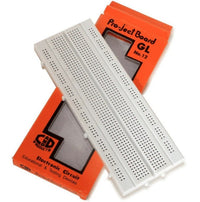
The GL12 840-Point Solderless Breadboard is a highly versatile and reusable electronic prototyping platform designed for rapid circuit development, testing, and experimentation without the need for soldering. It is widely used by students, hobbyists, educators, engineers, and embedded system developers for building temporary and semi-permanent electronic circuits quickly and efficiently. Its standardized layout, reliable electrical connectivity, and durable construction make it an essential tool in electronics laboratories, educational institutions, research environments, and DIY project development.
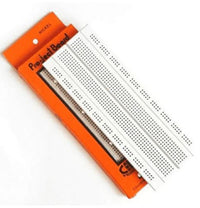
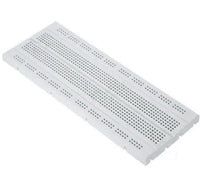
The breadboard provides a total of 840 tie-points, offering ample space for constructing complex circuits involving integrated circuits (ICs), microcontrollers, sensors, communication modules, LEDs, transistors, resistors, capacitors, relays, and various electronic components. The spacious layout allows users to organize components neatly while simplifying troubleshooting, modifications, and circuit expansion during development and testing stages.
One of the major advantages of the GL12 840-Point Solderless Breadboard is its solderless design. Unlike traditional PCB soldering methods, components can be inserted directly into the breadboard holes and removed easily without damaging the components or the board. This makes the breadboard highly suitable for educational learning, experimental prototyping, and rapid design iterations where circuits frequently need to be modified or rebuilt.
The breadboard is constructed using high-quality ABS plastic material that provides excellent durability, heat resistance, and mechanical strength. The internal conductive contacts are made from high-grade phosphor bronze or nickel-plated spring metal clips designed to maintain secure electrical connections even after repeated insertion and removal of components. These spring clips ensure stable conductivity and minimize loose connections during operation, improving the reliability of experimental circuits.
The standard 2.54 mm (0.1-inch) hole spacing used in the GL12 breadboard ensures compatibility with a wide range of electronic components and development platforms. Most through-hole components, DIP integrated circuits, jumper wires, and connector pins fit perfectly into the breadboard layout. This standardized spacing also allows seamless interfacing with popular development boards such as Arduino Uno R3, Raspberry Pi 4 Model B, Raspberry Pi Zero 2 W, NodeMCU boards, ESP32 modules, and other embedded development platforms.
The internal structure of the breadboard is divided into terminal strips and power rails for efficient circuit organization. The central terminal area is specifically designed to support dual in-line package (DIP) integrated circuits by separating the two rows of pins across a center gap. This configuration simplifies IC placement and circuit wiring for microcontrollers, logic ICs, operational amplifiers, and communication chips.
The side power rails provide dedicated rows for distributing power supply and ground connections throughout the circuit. These rails help maintain clean and organized wiring while simplifying voltage distribution across multiple components. Users can connect external power supplies, battery modules, or regulated voltage sources directly to the power rails for convenient circuit powering.
An adhesive backing is included on the underside of the breadboard, allowing secure mounting on workbenches, project boards, acrylic sheets, robot chassis, or inside custom enclosures. This feature improves stability during experimentation and prevents accidental movement while connecting components or testing circuits.
The GL12 840-Point Solderless Breadboard is especially useful for educational purposes because it enables students to learn circuit design, electronics fundamentals, and embedded system development through hands-on experimentation. Beginners can safely build and modify circuits without requiring soldering tools or permanent assembly methods. This encourages practical learning of concepts such as voltage distribution, current flow, signal processing, digital logic, sensor interfacing, and microcontroller programming.
In research and prototyping environments, the breadboard allows engineers and developers to quickly test circuit concepts before designing printed circuit boards (PCBs). This rapid prototyping capability reduces development time, lowers cost, and simplifies debugging during early design stages. Designers can experiment with component values, modify wiring connections, and evaluate system behavior in real time.
The breadboard is also widely used in robotics, IoT development, automation systems, and embedded electronics projects. It enables temporary integration of sensors, communication modules, motor drivers, relays, displays, and microcontrollers during software testing and hardware validation. This flexibility is especially valuable when developing proof-of-concept systems and demonstration models.
Another important benefit of the GL12 840-Point Breadboard is its reusability. Since no soldering is involved, the same board can be used repeatedly for different projects over a long period. This makes it both economical and environmentally friendly for educational institutions, laboratories, and electronics enthusiasts who regularly build experimental circuits.
The breadboard supports low-voltage DC electronic applications and is ideal for testing analog circuits, digital logic circuits, sensor interfaces, communication systems, power regulation circuits, timing circuits, and embedded controller systems. It is commonly used with jumper wires of various lengths and colors to simplify circuit tracing and improve visual organization.
Its compact yet spacious design makes the breadboard suitable for desktop workstations, portable electronics kits, laboratory benches, and classroom environments. Multiple breadboards can also be connected together for constructing larger and more complex circuit systems when additional prototyping space is required.
The GL12 840-Point Solderless Breadboard plays a vital role in electronics innovation and practical experimentation. Whether used for beginner learning, academic research, industrial prototyping, or hobby electronics, it provides a simple, reliable, and efficient platform for building and testing electronic circuits quickly without permanent assembly.
Overall, the GL12 840-Point Solderless Breadboard is an essential electronic development tool that combines convenience, reliability, flexibility, and durability in a reusable prototyping platform. Its standardized layout, strong electrical connections, compatibility with modern development boards, and user-friendly design make it an ideal solution for electronics education, circuit testing, embedded system development, robotics, IoT applications, and rapid prototyping projects.
| Vendor | electro robo store |
|---|---|
| Type | Accessories |
| Sku | MT1152 |
| Barcode | true |
