


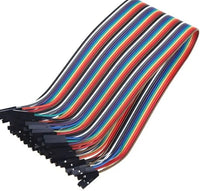
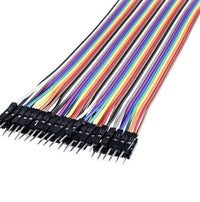
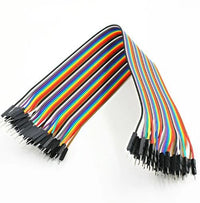


Female to Female Jumper Wires (20cm) 40pcs
Rs. 50.00
QUICK OVERVIEW
- Female to Female Jumper Wires (20 cm, 40 PCS) The Female to Female Jumper Wires (20 cm, 40 PCS) are highly useful an...
- These jumper wires are widely used in electronics laboratories, embedded system development, robotics, IoT applicatio...
- Their reusable design, flexibility, and compatibility with standard electronic connectors make them an indispensable ...
- This Female-to-Female configuration is especially useful for linking modules that expose male pin headers, allowing c...
🚚 Item will be delivered on or before

Female to Female Jumper Wires (20 cm, 40 PCS)
The Female to Female Jumper Wires (20 cm, 40 PCS) are highly useful and essential electronic prototyping accessories designed for creating fast, secure, and solderless electrical connections between development boards, sensor modules, communication devices, and various embedded electronic components. These jumper wires are widely used in electronics laboratories, embedded system development, robotics, IoT applications, automation projects, educational training kits, and DIY electronics experimentation. Their reusable design, flexibility, and compatibility with standard electronic connectors make them an indispensable tool for students, hobbyists, engineers, and professional developers working on rapid circuit prototyping and hardware testing.
Each jumper wire is equipped with female socket connectors on both ends, enabling direct connection between male header pins commonly found on microcontroller boards, sensors, relay modules, communication modules, display units, and expansion shields. This Female-to-Female configuration is especially useful for linking modules that expose male pin headers, allowing clean and reliable interconnections without requiring soldering or custom connectors.
The jumper wires are manufactured using high-quality insulated copper conductors that provide excellent electrical conductivity and stable signal transmission. The copper core ensures efficient flow of electrical power and communication signals while minimizing resistance and signal loss. The external insulation layer protects the wires from accidental short circuits, mechanical damage, and electrical interference, improving circuit reliability and user safety during experimentation and testing.
Designed with the industry-standard 2.54 mm connector pitch, these jumper wires are fully compatible with a wide range of popular development boards and electronic modules. They can be easily used with platforms such as Arduino Uno R3, Raspberry Pi 4 Model B, Raspberry Pi Zero 2 W, ESP32 development boards, NodeMCU modules, sensor breakout boards, relay modules, motor driver boards, LCD displays, and various embedded system components. This universal compatibility makes the jumper wire set suitable for countless electronics and automation applications.
The 20 cm wire length offers an excellent balance between flexibility and circuit organization. It provides enough reach to connect components positioned at moderate distances on breadboards, development platforms, and project setups while avoiding unnecessary wire clutter. This helps maintain neat circuit layouts, improves visibility during debugging, and simplifies modifications during development and testing.
The set usually contains 40 individual jumper wires in multiple colors, allowing users to organize wiring connections efficiently through color coding. Different wire colors can be assigned to power lines, ground connections, signal paths, communication buses, or control circuits. This organized wiring approach greatly improves troubleshooting, maintenance, and readability in complex electronic circuits.
The Female to Female jumper wires are particularly useful in modular electronic systems where multiple sensor modules and peripheral devices need to be interconnected. They allow developers to connect devices directly without permanent assembly, enabling rapid hardware integration and easy circuit modifications during prototyping stages.
These wires are extensively used with GL12 840-Point Solderless Breadboard and other prototyping tools in solderless development environments. Since no soldering is required, components can be connected, removed, and rearranged repeatedly without damaging either the components or the jumper wires. This reusable functionality significantly reduces development cost and increases flexibility for experimental electronics work.
In educational institutions and training laboratories, Female to Female jumper wires help students learn practical electronics concepts through hands-on circuit assembly and experimentation. Students can easily interface sensors, modules, and development boards while understanding topics such as electrical connections, signal flow, GPIO interfacing, voltage distribution, and communication protocols. Their simple plug-and-play design makes them beginner-friendly and highly suitable for classroom learning.
In IoT and embedded system applications, these jumper wires are commonly used to connect sensors and communication modules to microcontrollers and single-board computers. Developers can quickly build prototypes involving Wi-Fi modules, Bluetooth devices, ultrasonic sensors, temperature sensors, gas sensors, RFID readers, displays, relays, and motor controllers without designing custom PCBs during initial development phases.
Robotics projects also benefit greatly from Female to Female jumper wires because robotic systems often require flexible temporary wiring during assembly, calibration, and troubleshooting. These wires simplify the integration of sensors, actuators, servo motors, motor drivers, and communication modules within robotic control systems.
The connectors are designed for repeated use and provide firm mechanical grip when attached to male header pins. This secure connection helps prevent accidental disconnections during testing, movement, or operation, improving the reliability of prototype systems and experimental circuits.
The lightweight and compact nature of the jumper wire set makes it easy to store, transport, and organize in electronics toolkits, laboratory drawers, portable development kits, and educational equipment boxes. Users can conveniently carry the wires for use in workshops, classrooms, field projects, and remote development environments.
These jumper wires support a wide variety of low-voltage electronic applications including digital communication systems, sensor interfacing, embedded control systems, automation circuits, relay switching systems, logic circuits, signal routing, and power distribution for small electronic devices. Their versatility allows them to be used in nearly every stage of electronics prototyping and testing.
Another major advantage of Female to Female jumper wires is the time-saving benefit they provide during circuit assembly. Developers can quickly connect and disconnect modules without requiring soldering equipment, reducing development complexity and enabling faster experimentation. This rapid prototyping capability is especially valuable in research projects, product development, and educational demonstrations.
Overall, the Female to Female Jumper Wires (20 cm, 40 PCS) are reliable, reusable, and highly versatile electronic accessories that greatly simplify circuit development and hardware interfacing. Their standard connector compatibility, strong electrical conductivity, flexible wire length, durable insulation, and solderless usability make them an essential component for electronics education, embedded system development, robotics, IoT applications, automation projects, and rapid prototyping environments. Whether used by beginners learning electronics or professionals developing advanced embedded systems, these jumper wires provide efficient, organized, and dependable electrical connectivity for a wide range of electronic applications.
| Vendor | electro robo store |
|---|---|
| Type | Jumper wires |
| Sku | MT0354 |
| Barcode | true |
