


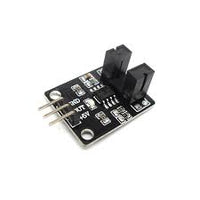
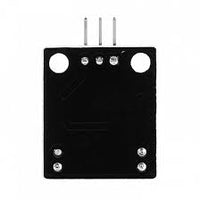
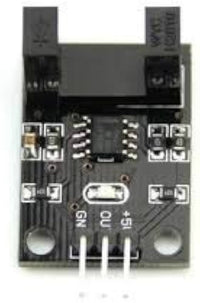


Correlation Photoelectric Infrared Count Slot Sensor
Rs. 50.00
(Incl. GST)
QUICK OVERVIEW
- Correlation Photoelectric Infrared Count Slot Sensor The Correlation Photoelectric Infrared Count Slot Sensor, also k...
- It operates using an infrared (IR) light emitter and a phototransistor receiver that face each other across a narrow gap
- This sensor is widely used in robotics, automation systems, encoder wheels, object counting machines, conveyor system...
- One side contains an infrared LED transmitter, while the opposite side contains an infrared phototransistor receiver
🚚 Item will be delivered on or before

Correlation Photoelectric Infrared Count Slot Sensor
The Correlation Photoelectric Infrared Count Slot Sensor, also known as an Infrared Slot Sensor, Photo Interrupter Sensor, or Optical Slot Sensor, is a non-contact optical sensor used to detect the presence, movement, position, or speed of an object passing through its slot. It operates using an infrared (IR) light emitter and a phototransistor receiver that face each other across a narrow gap. This sensor is widely used in robotics, automation systems, encoder wheels, object counting machines, conveyor systems, 3D printers, CNC machines, industrial equipment, and educational electronics projects.
The sensor consists of two main parts integrated into a U-shaped housing. One side contains an infrared LED transmitter, while the opposite side contains an infrared phototransistor receiver. A slot is provided between the transmitter and receiver through which an object, disc, or flag passes. The housing is generally made from durable black plastic that blocks external light interference and improves sensing accuracy. The sensor has connection terminals or pins for power supply, ground, and output signal.
The working principle of the Correlation Photoelectric Infrared Count Slot Sensor is based on the interruption of an infrared light beam. Under normal conditions, the infrared LED continuously emits infrared light toward the phototransistor. When no object is present in the slot, the receiver detects the infrared light and produces a corresponding electrical output. When an opaque object passes through the slot, it blocks the infrared beam, preventing it from reaching the receiver. The receiver immediately changes its output state, generating a digital signal that indicates the presence or movement of the object. This rapid switching enables accurate counting, position detection, and speed measurement.
The sensor is commonly connected to microcontrollers such as Arduino, ESP32, Raspberry Pi, PIC, AVR, and STM32. The output signal is read through a digital input pin or interrupt pin, allowing the controller to count pulses, measure rotational speed, detect object movement, or determine position. When used with a slotted encoder disc attached to a motor shaft, the sensor generates pulses that can be used to calculate motor speed (RPM), direction, and angular position.
The sensor operates with a low DC supply voltage, typically 3.3V to 5V, making it compatible with most embedded systems and development boards. It provides fast response time, high detection accuracy, and stable performance even during continuous operation.
The applications of the Correlation Photoelectric Infrared Count Slot Sensor include object counting systems, rotary encoder circuits, motor speed measurement, RPM counters, conveyor belt monitoring, industrial automation, production line counting, paper detection, printer mechanisms, CNC machines, 3D printers, robotic wheel encoders, position sensing, motion detection, smart vending machines, security systems, embedded systems, educational electronics, and DIY robotics projects.
The advantages of the Correlation Photoelectric Infrared Count Slot Sensor include non-contact detection, high sensitivity, fast response speed, accurate object counting, low power consumption, compact size, long operating life, reliable performance, immunity to mechanical wear, simple interfacing with microcontrollers, and compatibility with a wide range of electronic systems. Its optical sensing method eliminates friction and provides highly reliable operation over long periods.
In conclusion, the Correlation Photoelectric Infrared Count Slot Sensor is a highly reliable optical sensing device used for detecting objects, measuring speed, counting pulses, and determining position through infrared beam interruption. Its fast response, accurate detection, compact design, and easy integration make it an essential component for robotics, industrial automation, embedded systems, motor control, and educational electronics projects.
| Vendor | electro robo store |
|---|---|
| Type | Correlation Photoelectric Infrared Count Slot Sensor |
| Sku | MT0447 |
| Barcode | true |
