


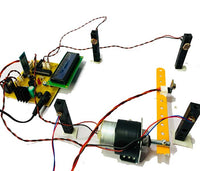

Automatic Temperature Detection for COVID Safety
Rs. 6,000.00
(Incl. GST)
QUICK OVERVIEW
- Automatic Temperature Detection for COVID Safety The Automatic Temperature Detection for COVID Safety Project is a sm...
- The project helps reduce physical contact during temperature screening and is suitable for use in public places, offi...
- It serves as an educational project for learning about embedded systems, sensors, automation, and health monitoring t...
- The sensor measures the infrared energy emitted from the forehead or skin surface and sends the temperature data to a...
🚚 Item will be delivered on or before

Automatic Temperature Detection for COVID Safety
The Automatic Temperature Detection for COVID Safety Project is a smart, contactless health monitoring system designed to measure a person's body temperature automatically using a non-contact infrared temperature sensor. The project helps reduce physical contact during temperature screening and is suitable for use in public places, offices, schools, hospitals, shopping malls, factories, and educational institutions. It serves as an educational project for learning about embedded systems, sensors, automation, and health monitoring technologies.
The project works by using a non-contact infrared temperature sensor to detect the body temperature of a person standing in front of the device. The sensor measures the infrared energy emitted from the forehead or skin surface and sends the temperature data to a microcontroller. The microcontroller processes the readings and displays the measured temperature on an LCD, OLED display, or serial monitor.
When the detected temperature is within the normal range, the system can display a "Normal Temperature" message or activate a green LED. If the temperature exceeds a predefined threshold, indicating a possible fever, the system can trigger a buzzer, red LED, or warning message to alert the operator. Some advanced versions may also control automatic door access, send notifications, or log temperature data for monitoring purposes.
The project is commonly built using components such as a microcontroller (Arduino, ESP32, NodeMCU, Raspberry Pi Pico, or similar), non-contact infrared temperature sensor (MLX90614 or similar), LCD/OLED display, buzzer, LEDs, power supply, and optional relay or servo motor for automatic access control.
The Automatic Temperature Detection for COVID Safety Project is compatible with popular development platforms including Arduino, ESP32, ESP8266, Raspberry Pi, STM32, PIC, AVR, and other programmable microcontrollers. It is easy to program using the Arduino IDE and other embedded development environments.
This project is widely used in educational electronics, engineering laboratories, health monitoring demonstrations, smart building automation, attendance systems, access control systems, hospitals, clinics, offices, schools, factories, public facilities, IoT applications, and embedded systems training. It demonstrates the integration of sensors, displays, alarms, and microcontrollers into a practical automation system.
The project offers several advantages, including contactless temperature measurement, fast response time, accurate temperature monitoring, improved hygiene, easy operation, low power consumption, compact design, and expandable functionality. Additional features such as face recognition, automatic hand sanitizer dispensing, cloud data logging, Wi-Fi connectivity, RFID attendance, and voice alerts can be integrated to create a more advanced smart safety system.
The Automatic Temperature Detection for COVID Safety Project is an excellent educational and automation project for students, engineers, hobbyists, and developers interested in health monitoring and embedded systems. Its simple implementation, reliable temperature sensing, contactless operation, and compatibility with various microcontrollers make it ideal for learning sensor interfacing, automation, and smart electronic system design.
| Vendor | electro robo store |
|---|---|
| Type | Automatic Temperature Detection for COVID Safety |
| Sku | MT1023 |
| Barcode | true |
