


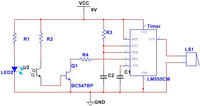

Automatic Door Bell Ringer Using IR Sensor and 555 Timer
Rs. 1,999.00
(Incl. GST)
QUICK OVERVIEW
- Automatic Door Bell Ringer Using IR Sensor and 555 Timer The Automatic Door Bell Ringer Using IR Sensor and 555 Timer...
- The project uses an Infrared (IR) sensor to detect the presence of a visitor and a 555 Timer IC to generate the requi...
- It is widely used as an educational project to demonstrate sensor interfacing, timer circuits, and basic electronic a...
- When a person passes within the sensing range, the reflected infrared light is detected by the IR receiver, generatin...
🚚 Item will be delivered on or before

Automatic Door Bell Ringer Using IR Sensor and 555 Timer
The Automatic Door Bell Ringer Using IR Sensor and 555 Timer Project is a simple electronic automation system designed to ring a doorbell automatically when a person approaches the entrance. The project uses an Infrared (IR) sensor to detect the presence of a visitor and a 555 Timer IC to generate the required timing signal for activating the doorbell or buzzer. It is widely used as an educational project to demonstrate sensor interfacing, timer circuits, and basic electronic automation.
The system operates by continuously monitoring the area in front of the door using an IR transmitter and IR receiver. When a person passes within the sensing range, the reflected infrared light is detected by the IR receiver, generating a trigger signal. This trigger activates the 555 Timer IC, which produces a timed output pulse to drive a buzzer, electronic doorbell, or relay. The doorbell rings automatically for a preset duration and then stops without requiring manual operation.
The 555 Timer IC can be configured in monostable mode, allowing the ringing duration to be adjusted by selecting appropriate resistor and capacitor values. This prevents continuous ringing while ensuring the visitor is clearly announced. The project operates with low power consumption and uses simple, inexpensive electronic components, making it suitable for beginners and educational laboratories.
The project typically consists of an IR sensor module or IR LED and photodiode pair, NE555 Timer IC, transistor driver, buzzer or electronic doorbell, resistors, capacitors, power supply, and PCB or breadboard. An optional relay module can be added to operate higher-power doorbells.
The Automatic Door Bell Ringer Using IR Sensor and 555 Timer Project is compatible with standard electronic circuit design and does not require a programmable microcontroller. It is ideal for learning the working principles of infrared sensing, timer circuits, pulse generation, transistor switching, and electronic control systems.
This project is widely used in homes, offices, educational laboratories, engineering colleges, electronics workshops, automation demonstrations, school science exhibitions, embedded electronics training, and DIY electronics projects. It helps students understand basic electronic automation, sensor operation, and timing circuit design.
The project offers several advantages, including automatic visitor detection, contactless operation, simple circuit design, low cost, low power consumption, reliable performance, adjustable ringing duration, and easy assembly. Additional features such as wireless notification, LED indicators, voice announcements, or smart home integration can be added to create a more advanced automatic doorbell system.
The Automatic Door Bell Ringer Using IR Sensor and 555 Timer Project is an excellent educational project for students, hobbyists, and electronics enthusiasts interested in automation and basic electronic circuit design. Its combination of infrared sensing, timer-based control, and automatic operation makes it an ideal platform for learning practical electronics, home automation, and sensor-based control systems.
| Vendor | electro robo store |
|---|---|
| Type | Automatic Door Bell Ringer Using IR Sensor and 555 Timer ₹ |
| Sku | MT1030 |
| Barcode | true |
