


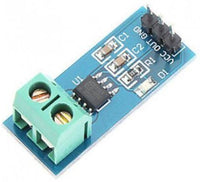
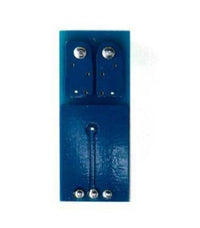


5A Range Current Sensor Module – ACS712
Rs. 84.00
(Incl. GST)
QUICK OVERVIEW
- Built around the highly reliable ACS712 Hall-effect current sensor IC, this module converts the current flowing throu...
- This provides electrical isolation between the sensing circuit and the output signal, improving safety while minimizi...
- The module is capable of measuring both positive and negative currents, making it suitable for bidirectional current ...
- As current flows through the sensor, the output voltage increases or decreases proportionally depending on the direct...
🚚 Item will be delivered on or before

5A Range Current Sensor Module – ACS712
The 5A Range Current Sensor Module – ACS712 is a precision Hall-effect current sensing module designed to accurately measure both AC and DC currents up to ±5A. Built around the highly reliable ACS712 Hall-effect current sensor IC, this module converts the current flowing through a conductor into a proportional analog voltage output, allowing microcontrollers and embedded systems to monitor electrical current safely and accurately.
Unlike traditional current sensing methods that require shunt resistors, the ACS712 uses Hall-effect technology to measure the magnetic field generated by current flow. This provides electrical isolation between the sensing circuit and the output signal, improving safety while minimizing power loss and heat generation. The module is capable of measuring both positive and negative currents, making it suitable for bidirectional current monitoring in a wide variety of electronic applications.
The module operates from a 5V DC supply and produces an analog output voltage centered around 2.5V when no current is flowing. As current flows through the sensor, the output voltage increases or decreases proportionally depending on the direction and magnitude of the current. This analog signal can be easily read using the analog input pins of popular microcontrollers such as Arduino, ESP32, ESP8266, Raspberry Pi (with an external ADC), STM32, AVR, PIC, and other embedded platforms.
Manufactured using high-quality electronic components, the ACS712 5A Current Sensor Module provides excellent accuracy, fast response time, low noise, and long-term stability. Its compact PCB design makes it easy to integrate into breadboards, prototype circuits, and custom PCBs, making it suitable for both educational projects and commercial product development.
The module is widely used in battery management systems (BMS), solar power monitoring, inverter systems, motor current monitoring, power supplies, smart energy meters, electric vehicles, robotics, industrial automation, home automation, UPS systems, IoT devices, laboratory instruments, and DIY electronics projects. It is also ideal for over-current protection, load monitoring, power consumption analysis, and fault detection.
Whether you are designing an energy monitoring system, building a smart power controller, or developing a battery-powered project, the 5A Range Current Sensor Module – ACS712 provides a reliable, accurate, and cost-effective solution for real-time current measurement.
Working Principle
The ACS712 Current Sensor Module operates using the Hall-effect principle.
When electrical current flows through the integrated copper conductor inside the ACS712 sensor, it generates a magnetic field around the conductor. The internal Hall-effect sensor detects this magnetic field and converts it into a proportional voltage signal without making direct electrical contact with the measured current.
With no current flowing, the output voltage is approximately 2.5V (half of the supply voltage). As positive current increases, the output voltage rises above 2.5V. When current flows in the opposite direction, the output voltage decreases below 2.5V. A microcontroller reads this analog voltage and calculates the actual current value using the sensor's sensitivity.
Since the sensing circuit is electrically isolated from the measured current path, the module provides safer operation and reliable performance in both low-voltage and higher-current applications.
Key Features
-
Measures both AC and DC current
-
Current measurement range: ±5A
-
Based on the ACS712 Hall-effect current sensor IC
-
Analog voltage output proportional to current
-
Hall-effect sensing with electrical isolation
-
Operates from a 5V DC power supply
-
Fast response time
-
High measurement accuracy
-
Low noise output
-
Low power consumption
-
Compact PCB module
-
Breadboard-friendly design
-
Easy integration with microcontrollers
-
Reliable long-term performance
-
Suitable for bidirectional current measurement
Applications
The 5A Range Current Sensor Module – ACS712 is widely used in:
-
Arduino projects
-
ESP32 development
-
ESP8266 IoT applications
-
Raspberry Pi projects (with ADC)
-
STM32 development boards
-
Battery Management Systems (BMS)
-
Solar power monitoring
-
Battery charging systems
-
Smart energy meters
-
Motor current monitoring
-
Motor control systems
-
Over-current protection
-
Power supply monitoring
-
UPS systems
-
Inverter monitoring
-
Robotics
-
Industrial automation
-
Home automation
-
IoT devices
-
Embedded systems
-
Laboratory testing equipment
-
Electronic measurement systems
-
DIY electronics projects
Specifications
-
Product Type: Hall-Effect Current Sensor Module
-
Sensor IC: ACS712
-
Current Measurement Range: ±5A
-
Current Type: AC and DC
-
Operating Voltage: 5V DC
-
Output Type: Analog Voltage
-
Output Voltage at 0A: Approximately 2.5V
-
Measurement Principle: Hall Effect
-
Isolation: Electrical isolation between sensing and output circuits
-
Mounting: Through-hole PCB module
-
Interface: Analog output
| Vendor | electro robo store |
|---|---|
| Type | 5A Range Current Sensor Module – ACS712 |
| Sku | MT0532 |
| Barcode | true |
