


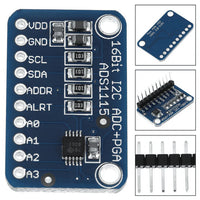

16 Bit I2C 4 Channel ADS1115 Module
Rs. 195.00
(Incl. GST)
QUICK OVERVIEW
- Built around the powerful ADS1115 16-bit ADC integrated circuit, this module enables microcontrollers and single-boar...
- Its high resolution, programmable gain amplifier, differential input capability, and easy I2C communication make it o...
- Many embedded platforms such as Raspberry Pi 4 Model B do not include built-in analog input capability, while some mi...
- The ADS1115 solves these limitations by offering highly accurate 16-bit analog-to-digital conversion with excellent m...
🚚 Item will be delivered on or before

16 Bit I2C 4 Channel ADS1115 ADC Module
The 16 Bit I2C 4 Channel ADS1115 Module is a high-precision analog-to-digital converter (ADC) module designed for microcontroller and embedded electronics applications that require accurate analog signal measurement and conversion. Built around the powerful ADS1115 16-bit ADC integrated circuit, this module enables microcontrollers and single-board computers to measure analog voltages with significantly higher precision compared to standard onboard ADCs available in many development platforms.
The ADS1115 module is widely used in sensor interfacing, industrial monitoring systems, IoT devices, robotics, automation systems, scientific instrumentation, and embedded measurement applications where accurate analog signal acquisition is essential. Its high resolution, programmable gain amplifier, differential input capability, and easy I2C communication make it one of the most popular external ADC modules for modern electronics development.
The primary function of the ADS1115 module is to convert analog voltage signals into digital data that can be processed by microcontrollers and computers. Many embedded platforms such as Raspberry Pi 4 Model B do not include built-in analog input capability, while some microcontrollers provide only limited ADC resolution. The ADS1115 solves these limitations by offering highly accurate 16-bit analog-to-digital conversion with excellent measurement flexibility.
The module provides 16-bit resolution, meaning it can represent analog signals with 65,536 discrete digital values. This high resolution enables extremely precise voltage measurement and improved sensitivity when working with small sensor signals and low-level analog outputs.
The ADS1115 supports sampling rates up to approximately 860 samples per second (SPS), making it suitable for many real-time monitoring and measurement applications. Although not intended for high-speed audio acquisition, the module performs exceptionally well in sensor measurement, environmental monitoring, and slow-to-medium-speed analog data acquisition systems.
Communication with the module is performed using the I2C interface, which requires only two communication lines:
-
SDA (Serial Data)
-
SCL (Serial Clock)
This simple communication method reduces wiring complexity and allows multiple devices to share the same communication bus efficiently.
The ADS1115 can be configured in two main input modes:
-
Four single-ended input channels
-
Two differential input channels
In single-ended mode, the module can independently measure four separate analog voltage inputs relative to ground. This configuration is ideal for reading sensors, potentiometers, analog modules, and variable voltage signals.
In differential mode, the module measures the voltage difference between two input signals. Differential measurement improves noise immunity and enables accurate detection of very small voltage differences, making it useful for industrial sensors, bridge circuits, and precision instrumentation systems.
One of the most powerful features of the ADS1115 is its built-in Programmable Gain Amplifier (PGA). The PGA allows users to amplify small input signals before analog-to-digital conversion, improving measurement sensitivity and resolution.
The programmable gain supports multiple selectable voltage ranges including:
-
±0.256V
-
±0.512V
-
±1.024V
-
±2.048V
-
±4.096V
-
±6.144V
These selectable input ranges allow the module to measure both very small and relatively large voltage signals accurately. By selecting an appropriate gain setting, users can maximize ADC resolution and improve precision for different sensor applications.
For example, low-voltage sensors such as thermocouples, strain gauges, and biomedical sensors benefit from high gain settings, while higher-voltage signals can use lower gain values for wider measurement range.
The ADS1115 module operates within a supply voltage range of approximately 2V to 5V DC, making it compatible with both 3.3V and 5V microcontroller systems. This flexibility allows easy interfacing with a wide variety of development platforms including:
-
Arduino Uno R3
-
Arduino Nano Board V3
-
ESP32 development boards
-
STM32 microcontrollers
-
NodeMCU systems
-
Raspberry Pi 4 Model B
-
PIC and AVR microcontrollers
The breakout board design includes onboard ferrite filtering components that help reduce electrical noise on the analog power and ground lines. This improves measurement stability and enhances ADC performance in noisy electrical environments.
Another major advantage of the ADS1115 is its configurable I2C address selection. The module supports up to four different I2C addresses, allowing multiple ADS1115 modules to share the same I2C bus simultaneously. This enables expansion up to:
-
16 single-ended analog inputs
-
8 differential analog channels
using four modules connected to a single I2C interface.
The module is highly popular in IoT and sensor monitoring systems where multiple analog sensors must be measured accurately. It is commonly used with temperature sensors, pressure sensors, gas sensors, current sensors, voltage monitoring circuits, and environmental sensing systems.
In industrial automation systems, the ADS1115 provides accurate analog signal acquisition for process monitoring, instrumentation, machine control, and industrial sensor interfacing.
Robotics projects use the module for precision sensor measurement, battery monitoring, motor current sensing, force sensing, and analog feedback systems. The high resolution improves control accuracy and sensor sensitivity.
Educational institutions and STEM learning environments frequently use the ADS1115 module to teach concepts related to analog electronics, signal conversion, sensor interfacing, I2C communication, and embedded systems design.
Typical applications of the ADS1115 ADC Module include:
-
Precision sensor interfacing
-
Industrial monitoring systems
-
IoT data acquisition
-
Environmental monitoring
-
Battery voltage measurement
-
Current sensing systems
-
Robotics and automation
-
Biomedical electronics
-
Scientific instrumentation
-
Analog signal analysis
-
Embedded measurement systems
-
Educational electronics projects
The module is also widely used in Raspberry Pi projects because the Raspberry Pi lacks native analog input pins. The ADS1115 provides an easy and efficient method for adding high-precision analog measurement capability to Raspberry Pi systems through the I2C interface.
Its compact PCB design allows easy integration into embedded systems, portable electronics, automation panels, and sensor monitoring devices. The module can be mounted directly onto breadboards or prototype circuits for rapid development.
Another important feature is its low power consumption, making it suitable for battery-powered IoT devices, remote monitoring systems, and portable embedded applications.
The ADS1115 also includes internal comparators and configurable alert functionality, enabling threshold-based monitoring and interrupt-driven measurement systems in advanced applications.
Because of its popularity, extensive software support is available for Arduino, Raspberry Pi, ESP32, STM32, and other embedded platforms. Numerous libraries, tutorials, and example projects simplify implementation for both beginners and professional developers.
Proper grounding, stable power supply design, and careful analog signal routing can further improve ADC accuracy and reduce measurement noise in sensitive applications.
Overall, the 16 Bit I2C 4 Channel ADS1115 Module is a powerful, accurate, and highly flexible analog-to-digital conversion solution designed for embedded electronics, sensor interfacing, IoT systems, industrial automation, and scientific measurement applications. Its 16-bit resolution, programmable gain amplifier, differential input capability, multiple voltage ranges, I2C communication interface, and compatibility with popular microcontroller platforms make it an excellent choice for students, hobbyists, engineers, and developers requiring high-precision analog measurement in modern electronic systems. Whether used for sensor monitoring, industrial control, robotics, or data acquisition applications, the ADS1115 module delivers reliable performance, accurate signal conversion, and versatile analog interfacing capability in a compact and easy-to-use design.
| Vendor | Electro Robo Store |
|---|---|
| Type | 16 Bit I2C 4 Channel ADS1115 Module |
| Sku | MT0234 |
| Barcode | true |
