


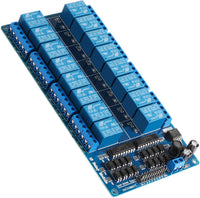



12V 16 Channel Relay Module Board
Rs. 579.00
(Incl. GST)
QUICK OVERVIEW
- Featuring sixteen independent relay channels, this module enables simultaneous control of up to sixteen separate elec...
- Each relay functions as an electrically operated switch capable of safely turning external AC or DC devices ON or OFF...
- Because of its multi-channel design and reliable switching capability, the module is widely used in applications requ...
- Each relay contains an internal electromagnetic coil and mechanical switching contacts
🚚 Item will be delivered on or before

12V 16 Channel Relay Module Board
The 12V 16 Channel Relay Module Board is a high-capacity electronic switching interface designed for controlling multiple high-voltage or high-current electrical devices using low-voltage digital control signals from microcontrollers, embedded systems, and industrial controllers. Featuring sixteen independent relay channels, this module enables simultaneous control of up to sixteen separate electrical loads, making it highly suitable for large-scale automation systems, industrial control applications, robotics, IoT systems, smart home projects, and advanced embedded electronics development.
Operating on a 12V DC power supply, the relay module acts as a bridge between low-power digital control electronics and high-power electrical devices. Each relay functions as an electrically operated switch capable of safely turning external AC or DC devices ON or OFF through software or electronic control signals. Because of its multi-channel design and reliable switching capability, the module is widely used in applications requiring centralized control of multiple electrical systems.
The working principle of the relay module is based on electromagnetic switching. Each relay contains an internal electromagnetic coil and mechanical switching contacts. When a control signal is applied to a relay input, the coil becomes energized and generates a magnetic field that mechanically changes the position of the switching contacts. This action either opens or closes the connected electrical circuit, allowing the module to control external devices electronically while maintaining electrical isolation between the control side and the load side.
The 16-channel configuration provides significant flexibility for automation and industrial systems where numerous devices must be controlled independently. A single relay module can simultaneously operate lighting systems, motors, pumps, fans, alarms, solenoids, industrial machines, and other electrical equipment, simplifying system design and reducing wiring complexity.
The module is commonly interfaced with popular development platforms such as Arduino Uno R3, Arduino Nano Board V3, Arduino Leonardo R3 Compatible Board, ESP32 controllers, NodeMCU modules, PLC systems, ARM development boards, AVR microcontrollers, PIC systems, and Raspberry Pi 4 Model B computers.
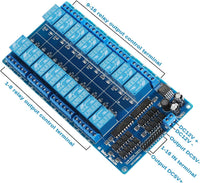
Each relay channel usually includes three output terminals:
-
Common (COM)
-
Normally Open (NO)
-
Normally Closed (NC)
These terminals provide flexible electrical connection options depending on application requirements. The Normally Open contact remains disconnected until the relay is activated, while the Normally Closed contact remains connected until activation occurs. This arrangement enables both automatic ON and automatic OFF switching configurations.
One of the major advantages of the relay module is its electrical isolation capability. Many versions include onboard optocoupler isolation circuits that protect sensitive microcontroller and control electronics from high-voltage interference, electrical noise, and voltage spikes generated by external loads.
Optocouplers transfer control signals using light rather than direct electrical connections, significantly improving system safety and noise immunity. This isolation is especially important in industrial automation systems and environments containing motors, relays, inductive loads, and AC mains-powered equipment.
The module also incorporates transistor driver circuits that amplify low-current microcontroller signals to levels sufficient for energizing the relay coils. These driver circuits reduce the load on microcontroller GPIO pins and improve switching reliability.
LED indicators are commonly provided for each relay channel, allowing users to visually monitor relay status during operation, troubleshooting, and testing. Additional power status LEDs help confirm module power availability and operational readiness.
The relay contacts are typically rated for switching loads up to:
-
AC 250V at 10A
-
DC 30V at 10A
These ratings allow the module to control a wide range of household appliances, industrial devices, and electrical systems. However, actual load handling capability may vary depending on the specific relay model and operating conditions.
The module is extensively used in industrial automation systems for machine control, process automation, motor management, emergency shutdown systems, and industrial monitoring applications. Its ability to manage multiple electrical loads from a single controller makes it highly valuable in centralized automation environments.
In smart home systems, the relay module is commonly used for controlling:
-
Lighting systems
-
Fans and air conditioning units
-
Water pumps
-
Smart door systems
-
Electrical outlets
-
Home appliances
-
Irrigation systems
-
Security devices
When combined with Wi-Fi or IoT-enabled microcontrollers, users can remotely control devices through mobile applications, cloud platforms, or voice-controlled automation systems.
Robotics and embedded systems projects use the module for switching motors, actuators, pumps, relays, solenoids, and external power systems. The multi-channel design enables complex automation sequences and coordinated control operations.
The relay board is also highly popular in IoT projects because it allows internet-connected devices to interact with real-world electrical systems safely and efficiently. Smart control systems can automate appliances based on sensor data, schedules, remote commands, or AI-based decision-making.
Educational institutions and engineering laboratories frequently use the 16-channel relay module to teach automation systems, electrical switching principles, industrial control systems, embedded programming, and power electronics concepts.
The board generally includes screw terminal connectors that provide secure wiring for high-voltage and high-current connections. Standard header pins allow easy interfacing with microcontrollers and embedded development boards.
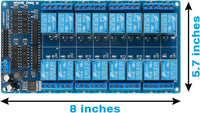
The PCB layout is designed for organized wiring and stable operation in both prototype and industrial environments. The module can be mounted inside control panels, automation cabinets, project enclosures, or embedded systems using standard mounting holes.
Because the module contains sixteen relay channels, proper power management is important. Operating all relays simultaneously may require a stable 12V power supply capable of delivering sufficient current to energize all relay coils reliably.
Community discussions and engineering recommendations frequently emphasize the importance of using adequate power supplies, proper grounding, flyback protection, and safe isolation practices when controlling high-power electrical systems using multi-channel relay boards.
Typical applications of the 12V 16 Channel Relay Module Board include:
-
Industrial automation systems
-
Smart home automation
-
IoT control systems
-
Electrical appliance switching
-
Lighting control systems
-
Motor and pump control
-
Security and alarm systems
-
Smart irrigation systems
-
Embedded control systems
-
Robotics and automation projects
-
Power management systems
-
PLC-based automation setups
-
Remote switching systems
-
Educational electronics laboratories
One of the significant benefits of using relay-based switching systems is complete electrical isolation between control electronics and high-voltage loads. Unlike transistor-only switching circuits, mechanical relay contacts physically separate the control and load circuits, improving safety and flexibility.
The module’s modular architecture simplifies maintenance and expansion. Individual channels can independently control different electrical systems, enabling scalable automation and customized control solutions.
Its durable construction and industrial-grade switching capability make the module suitable for continuous operation in demanding environments. Proper installation, load management, and safe wiring practices can significantly improve reliability and operational lifespan.
The extensive availability of software libraries, Arduino examples, Raspberry Pi GPIO tutorials, and embedded programming resources simplifies integration for both beginners and professional developers.
Overall, the 12V 16 Channel Relay Module Board is a powerful, reliable, and highly versatile electrical switching solution designed for controlling multiple high-voltage or high-current devices safely through low-voltage embedded control systems. Its sixteen independent relay channels, optocoupler isolation, driver circuitry, flexible connection terminals, and compatibility with popular microcontroller platforms make it an ideal choice for industrial automation, smart home systems, robotics, IoT applications, and advanced embedded electronics projects. Whether used in automation control panels, intelligent switching systems, or remote electrical management applications, this relay module delivers dependable performance, flexible control capability, and efficient multi-device switching functionality.
| Vendor | Electro Robo Store |
|---|---|
| Type | 12V 16 Channel Relay Module Board |
| Sku | MT1459 |
| Barcode | true |
