


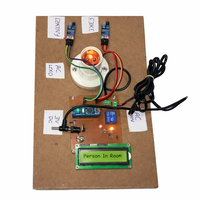


Automatic Room Light Controller with Bidirectional Visitor Counter
Rs. 1,490.00
QUICK OVERVIEW :-
- Automatic Room Light Controller with Bidirectional Visito....
- The project combines infrared (IR) sensor technology, mic....
- It is an excellent educational project for learning embed....
- The system uses two IR sensors installed at the entrance ....
🚚 Item will be delivered on or before

Automatic Room Light Controller with Bidirectional Visitor Counter Project
The Automatic Room Light Controller with Bidirectional Visitor Counter Project is an intelligent embedded electronics and automation system designed to automatically control room lighting based on the number of people entering and leaving a room. The project combines infrared (IR) sensor technology, microcontroller-based processing, and automatic light control to improve energy efficiency by ensuring that lights remain ON only when the room is occupied and switch OFF automatically when the room becomes empty. It is an excellent educational project for learning embedded systems, sensor interfacing, automation, and energy management.
The system uses two IR sensors installed at the entrance of a room to detect the direction of movement. By monitoring the sequence in which the sensors are triggered, the microcontroller determines whether a person is entering or exiting the room. Every entry increases the visitor count, while every exit decreases the count. The current number of people inside the room is continuously displayed on an LCD or 7-segment display, allowing users to monitor room occupancy in real time.
When the first person enters the room, the microcontroller automatically activates a relay module to switch ON the room light. As long as one or more people remain inside, the light stays ON. When the last person exits and the visitor count reaches zero, the controller automatically switches OFF the light, eliminating unnecessary electricity consumption and improving overall energy efficiency.
The Automatic Room Light Controller with Bidirectional Visitor Counter Project features a compact design, low power consumption, and reliable performance. The relay module safely controls high-voltage electrical appliances while maintaining electrical isolation from the low-voltage microcontroller circuit. The system is highly accurate in detecting entry and exit movements and can be expanded by integrating additional features such as Bluetooth control, Wi-Fi connectivity, GSM notifications, IoT monitoring, motion sensors, or cloud-based occupancy management systems.
The project provides valuable hands-on experience in microcontroller programming, IR sensor interfacing, digital electronics, relay control, visitor counting algorithms, and automation technology. Students learn how embedded systems process sensor data, make intelligent decisions, and control electrical appliances automatically based on real-time conditions.
The Automatic Room Light Controller with Bidirectional Visitor Counter Project is widely used in schools, colleges, engineering laboratories, diploma institutions, STEM education centers, science exhibitions, technical workshops, and research demonstrations. It is also suitable for practical applications in homes, offices, classrooms, conference halls, libraries, laboratories, shopping areas, and other public spaces where automatic lighting and occupancy monitoring help reduce energy consumption and improve operational efficiency.
Working Principle
The project operates using two infrared sensors placed at the entrance of the room. These sensors detect the movement of people entering or leaving by monitoring the order in which the sensors are activated.
When a person enters the room, the sensors generate signals that indicate an entry sequence. The microcontroller increases the visitor count by one and checks whether the room was previously empty. If the visitor count becomes one, the controller activates the relay module and switches ON the room light.
When a person leaves the room, the sensors detect the exit sequence. The microcontroller decreases the visitor count accordingly. If the visitor count reaches zero, the controller automatically deactivates the relay module and switches OFF the room light.
The visitor count is continuously updated and displayed on an LCD or 7-segment display, providing accurate real-time occupancy information while ensuring efficient energy management.
Key Features
-
Automatic room light ON/OFF control.
-
Bidirectional visitor counting.
-
Infrared sensor-based entry and exit detection.
-
Microcontroller-based intelligent control.
-
Real-time visitor count display.
-
LCD or 7-segment display support.
-
Relay-controlled appliance switching.
-
Low power consumption.
-
Compact and reliable design.
-
High counting accuracy.
-
Easy installation and programming.
-
Expandable with IoT, Wi-Fi, Bluetooth, or GSM modules.
Benefits
-
Reduces unnecessary electricity consumption.
-
Automatically controls room lighting.
-
Provides accurate visitor counting.
-
Demonstrates practical automation technology.
-
Improves energy efficiency.
-
Offers hands-on learning in embedded systems.
-
Easy to assemble, program, and maintain.
-
Supports future upgrades with smart automation features.
Applications
The Automatic Room Light Controller with Bidirectional Visitor Counter Project is widely used in:
-
Smart home automation
-
Office automation
-
Classrooms
-
Conference halls
-
Libraries
-
Laboratories
-
Shopping malls
-
Hospitals
-
Hotels
-
Engineering mini projects
-
College and university laboratories
-
Diploma and polytechnic practicals
-
Science exhibitions
-
STEM education programs
-
Technical workshops
Educational Value
This project helps students understand several important engineering and technology concepts, including:
-
Embedded Systems
-
Microcontroller Programming
-
IR Sensor Technology
-
Visitor Counting Algorithms
-
Relay Interfacing
-
Home and Building Automation
-
Digital Electronics
-
Sensor Interfacing
-
Energy Management Systems
-
Automation Technology
-
Electronics Engineering
-
Smart Control Systems
Students gain practical experience in designing intelligent automation systems that detect human movement, count occupancy, and automatically control electrical appliances based on real-time sensor data.
Package Contents
The kit may include the following components depending on the selected model:
-
Microcontroller development board
-
IR sensor modules
-
Relay module
-
LCD or 7-segment display
-
Power supply module
-
Connecting wires
-
Breadboard or PCB
-
Electronic components
-
User manual
-
Project documentation
Suitable For
-
Engineering students
-
Diploma students
-
Polytechnic students
-
School students
-
Electronics hobbyists
-
STEM education centers
-
Colleges and universities
-
Technical training institutes
-
DIY makers
-
Automation enthusiasts
-
Research students
-
Science exhibition participants
Why Choose This Automatic Room Light Controller with Bidirectional Visitor Counter Project?
The Automatic Room Light Controller with Bidirectional Visitor Counter Project is an ideal educational and practical solution for learning embedded systems, automation, visitor counting, and intelligent energy management. It combines IR sensor technology, microcontroller programming, relay-based appliance control, and real-time occupancy monitoring to create an efficient and reliable automation system. Its modular design, reusable components, low power consumption, and easy scalability make it an excellent choice for engineering projects, laboratory experiments, science exhibitions, technical workshops, and smart building demonstrations. This project provides valuable hands-on experience in sensor interfacing, automation, embedded programming, and energy-saving technologies while helping learners understand the practical implementation of modern intelligent lighting control systems.
| Vendor | Electro Robo Store |
|---|---|
| Type | Automatic Room Light Controller with Bidirectional Visitor Counter |
| Sku | MT2042 |
| Barcode | true |
