


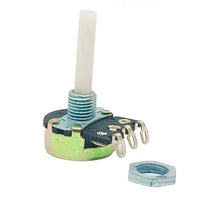

100k Ohm Linear Rotary Potentiometer (100k Ω Adjustable Variable Resistor)
Rs. 15.00
QUICK OVERVIEW :-
- 100K Ohm Linear Rotary Potentiometer (100KΩ Adjustable Va....
- With a maximum resistance of 100K Ohms (100,000Ω) and a l....
- This rotary potentiometer consists of a durable resistive....
- By changing the position of the wiper, the potentiometer ....
🚚 Item will be delivered on or before

100K Ohm Linear Rotary Potentiometer (100KΩ Adjustable Variable Resistor)
The 100K Ohm Linear Rotary Potentiometer (100KΩ Adjustable Variable Resistor) is a high-quality variable resistor designed to provide smooth and accurate manual adjustment of voltage, current, and signal levels in electronic circuits. With a maximum resistance of 100K Ohms (100,000Ω) and a linear taper, this potentiometer delivers a uniform change in resistance throughout its rotation, making it ideal for applications requiring precise and predictable control.
This rotary potentiometer consists of a durable resistive element, a rotating shaft, and a movable wiper that slides across the resistive track as the shaft is turned. By changing the position of the wiper, the potentiometer adjusts the resistance or output voltage, making it suitable for voltage divider circuits, signal conditioning, analog control, calibration, and sensor adjustment.
Manufactured using premium-quality resistive materials and corrosion-resistant metal contacts, the potentiometer offers excellent electrical stability, low noise, smooth rotational movement, and a long mechanical lifespan. The robust metal shaft is compatible with standard control knobs, while the threaded bushing allows secure panel mounting for professional and reliable installation in electronic equipment.
The 100K Ohm Linear Rotary Potentiometer is widely used in Arduino, ESP32, ESP8266, Raspberry Pi, STM32, audio amplifiers, power supplies, robotics, industrial automation, instrumentation, embedded systems, DIY electronics, educational kits, laboratory equipment, and electronic repair applications. It is commonly used for adjusting audio levels, controlling LED brightness, regulating motor speed, calibrating sensors, tuning analog circuits, and setting reference voltages.
Its compact size, simple three-terminal configuration, and dependable performance make it an essential component for engineers, technicians, students, makers, and electronics enthusiasts working on a variety of analog and digital projects.
Working Principle
The potentiometer operates by varying resistance through the rotation of its shaft.
-
Two outer terminals are connected to the ends of a resistive element.
-
The center terminal is connected to a movable wiper.
-
Rotating the shaft moves the wiper along the resistive track.
-
This changes the resistance between the center terminal and either outer terminal.
-
When connected as a voltage divider, the output voltage changes proportionally with the shaft position.
-
When used as a variable resistor (rheostat), it controls current by adjusting resistance.
Because it has a linear taper, the resistance changes evenly across the full rotation, making it ideal for precision adjustment and calibration applications.
Key Features
-
Resistance value: 100KΩ (100,000 Ohms)
-
Linear taper for uniform resistance adjustment
-
Smooth and precise rotary operation
-
Adjustable variable resistor
-
Three-terminal configuration
-
High electrical stability
-
Low noise performance
-
Durable resistive element
-
Corrosion-resistant metal contacts
-
Long mechanical operating life
-
Standard rotary shaft compatible with control knobs
-
Threaded bushing for secure panel mounting
-
Compact and lightweight design
-
Easy PCB and panel installation
-
Reliable long-term performance
Applications
The 100K Ohm Linear Rotary Potentiometer is widely used in:
-
Arduino projects
-
ESP32 development
-
ESP8266 projects
-
Raspberry Pi electronics
-
STM32 development boards
-
Analog input circuits
-
Voltage divider circuits
-
Sensor calibration
-
Signal adjustment
-
Audio amplifiers
-
Volume control circuits
-
Tone control systems
-
LED brightness control
-
Motor speed regulation
-
Power supply adjustment
-
Robotics
-
Industrial automation
-
Embedded systems
-
Laboratory instruments
-
Test and measurement equipment
-
DIY electronics
-
Educational electronics
-
Electronic repair and maintenance
Specifications
-
Product Type: Linear Rotary Potentiometer
-
Resistance Value: 100KΩ (100,000 Ohms)
-
Taper Type: Linear
-
Number of Terminals: 3
-
Adjustment Method: Rotary Shaft
-
Mounting Type: Panel Mount / PCB Mount (depending on model)
-
Shaft Material: Metal
-
Body Material: High-quality insulating plastic with metal housing
-
Operating Principle: Variable resistor / Voltage divider
-
Mechanical Rotation: Approximately 270° (varies by model)
| Vendor | Electro Robo Store |
|---|---|
| Type | 100k Ohm Linear Rotary Potentiometer (100k Ω Adjustable Variable Resistor) |
| Sku | MT0166 |
| Barcode | ture |
