




Soil Moisture Sensor Module
Rs. 37.00
QUICK OVERVIEW
- Soil Moisture Sensor Module The Soil Moisture Sensor Module is an electronic sensing device designed to measure the m...
- It is widely used in smart irrigation systems, automated agriculture, greenhouse monitoring, plant care systems, envi...
- By continuously monitoring soil moisture conditions, the sensor helps maintain proper watering levels for plants and ...
- The sensor can be integrated into automated systems that monitor soil conditions and activate irrigation mechanisms w...
🚚 Item will be delivered on or before

Soil Moisture Sensor Module
The Soil Moisture Sensor Module is an electronic sensing device designed to measure the moisture level or water content present in soil. It is widely used in smart irrigation systems, automated agriculture, greenhouse monitoring, plant care systems, environmental monitoring, and IoT-based farming applications. By continuously monitoring soil moisture conditions, the sensor helps maintain proper watering levels for plants and improves efficient water management in agricultural and gardening systems.
This module is highly popular among students, hobbyists, farmers, researchers, and embedded system developers because of its simple operation, low cost, and easy interfacing with popular microcontroller platforms. The sensor can be integrated into automated systems that monitor soil conditions and activate irrigation mechanisms whenever the soil becomes dry.
The working principle of the Soil Moisture Sensor Module is based on measuring the electrical resistance or conductivity between two conductive probes inserted into the soil. Moist soil conducts electricity more effectively than dry soil because water increases ionic conductivity within the soil.
When the soil contains higher moisture levels, electrical resistance between the probes decreases. When the soil becomes dry, resistance increases. The onboard signal conditioning circuit converts this resistance variation into measurable electrical signals that can be read by microcontrollers and automation systems.
The module generally provides two output interfaces:
-
Analog Output (AO)
-
Digital Output (DO)
The analog output provides a continuously varying voltage proportional to the soil moisture level. This allows microcontrollers to measure moisture percentage more accurately and perform advanced monitoring, logging, and irrigation control operations.
The digital output provides a HIGH or LOW signal depending on a preset moisture threshold value. When soil moisture falls below the configured threshold, the module changes the digital output state, enabling automatic control of pumps, relays, alarms, or irrigation systems.
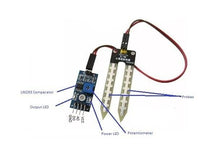
An onboard potentiometer allows users to adjust the moisture sensitivity threshold according to soil conditions and application requirements. This feature makes the module flexible for different agricultural, gardening, and environmental monitoring applications.
The module typically operates within a supply voltage range of:
3.3\text{V} \text{ to } 5\text{V DC}
making it compatible with a wide variety of embedded development platforms and IoT systems.
The Soil Moisture Sensor Module can easily interface with platforms such as:
-
Arduino Uno R3
-
Arduino Nano Board V3
-
Arduino Leonardo R3 Compatible Board – ATmega32U4 USB Development Board
-
ESP32 development boards
-
ESP8266 NodeMCU systems
-
Raspberry Pi 4 Model B
-
Raspberry Pi Zero 2 W
-
PLC and industrial control systems
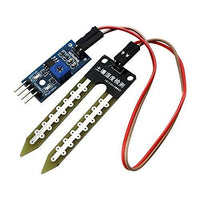
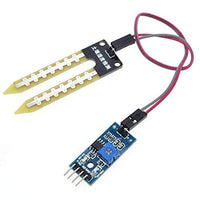
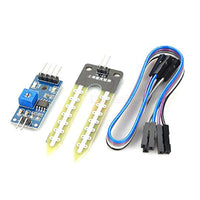
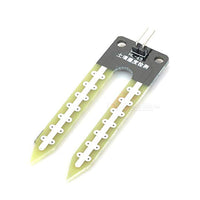
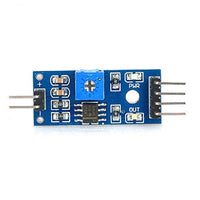
The sensor module usually consists of two main sections:
-
Soil moisture probe
-
Comparator and signal conditioning board
The probe contains conductive tracks or electrodes inserted directly into the soil. The signal conditioning board processes the electrical signals and generates stable analog and digital outputs.
The module commonly includes onboard LED indicators:
-
Power LED for supply indication
-
Output LED for moisture threshold indication
These indicators simplify calibration, testing, and troubleshooting during system development.
The Soil Moisture Sensor Module is widely used in smart irrigation systems where it automatically monitors soil conditions and activates water pumps only when necessary. This helps reduce water wastage and improves irrigation efficiency.
In agriculture and greenhouse applications, the sensor enables real-time monitoring of soil conditions to ensure proper plant growth and crop management. Automated irrigation systems can maintain consistent moisture levels without manual intervention.
Home gardening systems also use the sensor for automatic plant watering applications. The module can detect dry soil and activate miniature pumps or relay-controlled watering systems to maintain healthy plant conditions.
When integrated with IoT-enabled controllers such as ESP32 or NodeMCU, the sensor can transmit soil moisture data wirelessly to cloud platforms, mobile applications, or remote monitoring dashboards. This enables remote agricultural monitoring and smart farming solutions.
The module is also commonly used in educational and STEM learning environments for teaching:
-
Sensor interfacing
-
Analog signal processing
-
Embedded system programming
-
Automation systems
-
IoT agriculture projects
-
Smart environmental monitoring
Students can gain practical experience with real-world agricultural automation and sensor-based control systems.
The sensor can easily interface with relay modules such as:
-
8 Channel Relay Module 5V DC
-
12V 16 Channel Relay Module Board
to automatically control:
-
Water pumps
-
Solenoid valves
-
Irrigation motors
-
Alarm systems
-
Sprinkler systems
The module is commonly used together with prototyping accessories such as:
-
GL12 840-Point Solderless Breadboard
-
MB102 830 Points Solderless Prototype PCB Breadboard
-
Jumper wires
-
Arduino development boards
Typical applications of the Soil Moisture Sensor Module include:
-
Smart irrigation systems
-
Automatic plant watering systems
-
Smart agriculture projects
-
Greenhouse automation
-
Hydroponics monitoring
-
Environmental monitoring systems
-
IoT farming applications
-
Water conservation systems
-
Educational electronics projects
-
Embedded automation systems
One important consideration when using resistive soil moisture sensors is probe corrosion during long-term exposure to moisture. Continuous DC voltage across the probes may gradually cause oxidation and material degradation. To improve sensor lifespan, developers often power the sensor only during measurement intervals instead of continuous operation.
Environmental conditions such as soil type, salinity, temperature, and fertilizer concentration may also influence sensor readings. Proper calibration improves measurement accuracy for specific soil conditions.
Another major advantage of the Soil Moisture Sensor Module is its affordability and ease of use. Its simple operation and broad compatibility make it highly suitable for beginner electronics projects as well as advanced automation systems.
The widespread availability of Arduino libraries, tutorials, IoT integration examples, and project documentation simplifies development and encourages experimentation in smart agriculture and embedded system design.
Overall, the Soil Moisture Sensor Module is a reliable, practical, and easy-to-integrate sensing solution for monitoring soil water content in agricultural, environmental, automation, and educational applications. Its analog and digital outputs, adjustable sensitivity, low operating voltage, and compatibility with popular microcontroller platforms make it an excellent choice for smart irrigation systems, IoT agriculture projects, greenhouse automation, embedded electronics, and DIY environmental monitoring systems.
| Vendor | electro robo store |
|---|---|
| Type | sensor |
| Sku | MT0112 |
| Barcode | true |
