


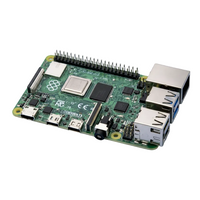
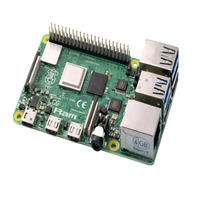
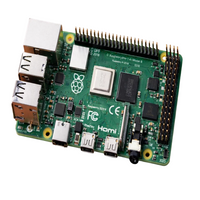
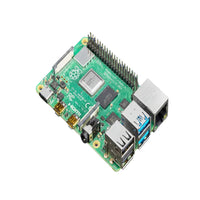
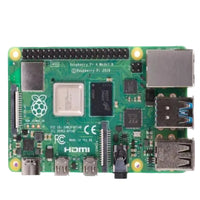


Raspberry Pi 4 Model B 4GB ram
Rs. 11,465.00
QUICK OVERVIEW
- Raspberry Pi 4 Model B (4GB RAM) The Raspberry Pi 4 Model B (4GB RAM) is a high-performance single-board computer des...
- Developed as part of the widely successful Raspberry Pi family, this board is suitable for education, embedded system...
- With substantial improvements in processor speed, memory capacity, graphics performance, connectivity, and I/O capabi...
- This advanced processor architecture delivers a significant increase in computational performance, enabling smooth mu...
🚚 Item will be delivered on or before

Raspberry Pi 4 Model B (4GB RAM)
The Raspberry Pi 4 Model B (4GB RAM) is a high-performance single-board computer designed to provide desktop-level computing capabilities in a compact, affordable, and energy-efficient platform. Developed as part of the widely successful Raspberry Pi family, this board is suitable for education, embedded system development, IoT applications, robotics, multimedia processing, networking solutions, industrial automation, and software development. With substantial improvements in processor speed, memory capacity, graphics performance, connectivity, and I/O capabilities compared to previous Raspberry Pi generations, the Raspberry Pi 4 Model B has become one of the most powerful and versatile development platforms available for students, hobbyists, researchers, and professionals.
At the core of the Raspberry Pi 4 Model B is a powerful quad-core 64-bit ARM Cortex-A72 processor running at 1.5 GHz. This advanced processor architecture delivers a significant increase in computational performance, enabling smooth multitasking, faster software execution, and improved responsiveness across a wide range of applications. Whether used for programming, web browsing, multimedia streaming, server hosting, or automation control, the processor provides reliable and efficient operation for both educational and industrial computing tasks.
The board includes 4GB of LPDDR4 RAM, which offers enhanced memory bandwidth and improved multitasking capability. This large memory capacity allows the system to handle multiple applications simultaneously without performance degradation. Users can run desktop applications, development tools, databases, lightweight virtual servers, and graphical interfaces efficiently. The improved memory architecture also benefits tasks involving image processing, data analysis, web applications, and multimedia playback.
One of the major highlights of the Raspberry Pi 4 Model B is its advanced multimedia and display support. The board includes dual micro-HDMI ports capable of driving two independent displays simultaneously at resolutions up to 4K. This feature transforms the Raspberry Pi into a capable workstation platform suitable for productivity applications, digital signage systems, multimedia centers, monitoring stations, and educational computing environments. The enhanced VideoCore graphics processor ensures smooth video playback, graphical rendering, and user interface performance.
The Raspberry Pi 4 Model B offers modern networking and wireless communication features that greatly enhance connectivity and internet-based applications. The board includes Gigabit Ethernet support for high-speed wired networking, making it ideal for server applications, network storage systems, industrial communication, and IoT gateways. Additionally, built-in dual-band 2.4 GHz and 5 GHz Wi-Fi provides reliable wireless connectivity with improved speed and network stability. Bluetooth 5.0 with BLE (Bluetooth Low Energy) enables communication with wireless peripherals, sensors, mobile devices, and smart systems.
The inclusion of USB 3.0 ports represents another major improvement in the Raspberry Pi 4 architecture. The board features two USB 3.0 ports and two USB 2.0 ports, allowing high-speed data transfer with external storage devices, cameras, sensors, keyboards, mice, printers, and other peripherals. USB 3.0 connectivity is particularly useful for applications involving large data transfer, external SSD storage, multimedia streaming, and backup systems.
The Raspberry Pi 4 Model B retains the standard 40-pin GPIO (General Purpose Input/Output) header that is compatible with the extensive Raspberry Pi ecosystem of sensors, modules, HATs, and accessories. Through the GPIO interface, users can connect relays, motors, LEDs, displays, sensors, communication modules, and industrial control systems. The board supports multiple communication protocols including GPIO digital control, PWM, UART serial communication, SPI, and I2C interfaces. These capabilities make it highly suitable for embedded systems, robotics, automation projects, and real-time monitoring applications.
The board runs a complete Linux-based operating system, typically Raspberry Pi OS, directly from a microSD card. This operating system environment provides access to a large collection of open-source software, programming tools, networking utilities, databases, and development libraries. Users can work with programming languages such as Python, C, C++, Java, Scratch, Node.js, and many others. The Linux platform also supports multitasking, remote access, web hosting, scripting, and software development, making the Raspberry Pi 4 Model B a complete and flexible computing solution.
Power delivery in the Raspberry Pi 4 Model B is handled through a modern USB Type-C connector, ensuring stable and efficient power supply to the system. The improved power architecture supports high-performance operation while maintaining energy efficiency. This enables the board to operate reliably in continuous-use applications such as servers, automation systems, kiosks, and remote monitoring installations.
The Raspberry Pi 4 Model B is widely used in educational institutions because it offers an affordable platform for learning computer science, programming, networking, Linux administration, robotics, and electronics integration. Students can gain hands-on experience with hardware and software development while working on real-world projects involving sensors, automation systems, web applications, and embedded computing.
In IoT and smart automation applications, the Raspberry Pi 4 serves as a powerful edge computing device capable of collecting sensor data, processing information locally, and communicating with cloud platforms or mobile applications. Its networking capabilities allow it to function as an IoT gateway, smart controller, or centralized automation server in industrial, agricultural, healthcare, and home automation environments.
The board is also highly popular in robotics and artificial intelligence projects due to its enhanced processing power and multimedia capabilities. It can manage motor control, computer vision systems, object detection, machine learning frameworks, and autonomous robotic navigation. Combined with camera modules and AI libraries, the Raspberry Pi 4 becomes a compact yet capable platform for intelligent embedded systems.
For media and entertainment applications, the Raspberry Pi 4 Model B can function as a home theater PC, streaming server, retro gaming console, or digital signage system. Its ability to output dual 4K video streams and process multimedia efficiently makes it ideal for high-quality media playback and interactive display solutions.
Another important advantage of the Raspberry Pi 4 ecosystem is the large global developer community and extensive software support. Thousands of tutorials, project examples, hardware accessories, open-source tools, and development libraries are readily available online. This strong ecosystem reduces development complexity and enables users to rapidly prototype and deploy innovative solutions.
The compact form factor of the Raspberry Pi 4 Model B allows it to be integrated into portable devices, industrial control panels, custom enclosures, kiosks, and embedded systems without requiring large installation space. Despite its small size, the board delivers performance comparable to entry-level desktop computers while consuming significantly less power.
Overall, the Raspberry Pi 4 Model B (4GB RAM) is a highly capable, flexible, and efficient single-board computer that bridges the gap between embedded systems and desktop computing. Its powerful quad-core processor, 4GB RAM, advanced multimedia support, modern connectivity options, Linux operating system compatibility, and GPIO expansion capabilities make it an excellent platform for education, research, automation, IoT development, robotics, networking, multimedia systems, and industrial applications. Whether used for learning, experimentation, or professional system development, the Raspberry Pi 4 Model B offers exceptional performance, reliability, and versatility in a compact and affordable computing platform.
| Vendor | electro robo store |
|---|---|
| Type | Raspberry Pi |
| Sku | MT0178 |
| Barcode | true |
