




Series and Parallel Circuit
Rs. 588.00
QUICK OVERVIEW :-
- Series and Parallel Circuit The Series and Parallel Circu....
- It demonstrates how electrical components such as resisto....
- This project provides a practical, hands-on learning expe....
- In a series circuit, electrical components are connected ....
🚚 Item will be delivered on or before

Series and Parallel Circuit
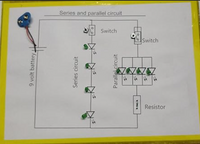
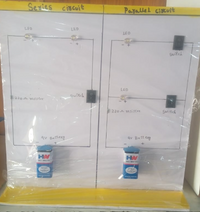
The Series and Parallel Circuit is a fundamental educational electronics project designed to help students understand the basic principles of electrical circuit design and analysis. It demonstrates how electrical components such as resistors, LEDs, bulbs, switches, and other passive devices behave when connected in series and parallel configurations. This project provides a practical, hands-on learning experience that helps learners visualize the flow of current, distribution of voltage, and calculation of resistance in different circuit arrangements.
In a series circuit, electrical components are connected one after another in a single path, allowing the same current to flow through every component. The supply voltage is divided across the connected components, while the total resistance increases as more components are added. If one component fails or the circuit is opened, the entire circuit stops functioning because there is only one current path.
In a parallel circuit, all components are connected across the same voltage source through separate branches. Each branch receives the full supply voltage, while the total current is divided among the branches according to their individual resistance values. If one branch is disconnected or fails, the remaining branches continue to operate independently, demonstrating the reliability and flexibility of parallel circuit configurations.
The project enables students to measure voltage, current, and resistance using standard instruments such as digital multimeters, allowing them to compare theoretical calculations with practical observations. Through experimentation, learners gain a clear understanding of Ohm's Law, Kirchhoff's Laws, equivalent resistance, current distribution, voltage division, power dissipation, and basic circuit analysis techniques.
The Series and Parallel Circuit project is easy to assemble using commonly available electronic components including resistors, bulbs, LEDs, switches, connecting wires, breadboards, batteries, and DC power supplies. It serves as an excellent educational model for schools, colleges, diploma programs, engineering laboratories, vocational training centers, and STEM learning environments.
This project forms the foundation for understanding more advanced topics in electrical engineering, electronics, robotics, embedded systems, industrial automation, and power distribution systems. It is suitable for beginners, students, teachers, hobbyists, and anyone interested in learning practical electronics through experimentation.
Key Features
-
Demonstrates both series and parallel circuit configurations
-
Hands-on learning of electrical principles
-
Practical understanding of voltage and current distribution
-
Easy to assemble using basic electronic components
-
Supports measurement of voltage, current, and resistance
-
Demonstrates equivalent resistance concepts
-
Ideal for educational laboratories
-
Suitable for beginners and engineering students
-
Reusable and easy to modify
-
Compatible with breadboards and PCB experiments
Applications
-
School science projects
-
Engineering laboratory experiments
-
Diploma practical sessions
-
STEM education
-
Electronics learning
-
Electrical engineering demonstrations
-
Circuit analysis training
-
Vocational education
-
DIY electronics projects
-
Basic electronics workshops
-
Research and educational demonstrations
Benefits
-
Improves practical understanding of circuit fundamentals
-
Reinforces theoretical electrical concepts
-
Develops troubleshooting skills
-
Enhances circuit design knowledge
-
Encourages hands-on experimentation
-
Easy to build and modify
-
Suitable for self-learning and classroom demonstrations
-
Provides a strong foundation for advanced electronics
Typical Components Used
-
Resistors
-
LEDs
-
Incandescent Bulbs
-
Breadboard
-
Connecting Wires
-
Battery or DC Power Supply
-
Switches
-
Digital Multimeter
-
Ammeter
-
Voltmeter
Working Principle
Series Circuit
-
Components are connected in a single continuous path.
-
The same current flows through every component.
-
The supply voltage is divided across the components.
-
Total resistance is equal to the sum of all individual resistances.
-
Failure of one component interrupts the entire circuit.
Parallel Circuit
-
Components are connected across the same voltage source.
-
Each branch receives the full supply voltage.
-
Current divides among the parallel branches.
-
Equivalent resistance decreases as more branches are added.
-
Failure of one branch does not affect the operation of the remaining branches.
Advantages
-
Simple and easy to understand
-
Excellent for practical learning
-
Demonstrates real electrical behavior
-
Cost-effective educational project
-
Suitable for classroom demonstrations
-
Helps develop analytical and measurement skills
-
Supports engineering and technical education
-
Provides the basis for advanced electrical and electronic circuit design
The Series and Parallel Circuit project is an essential educational tool that helps students understand the core principles of electrical circuits through practical experimentation. It provides valuable experience in circuit construction, measurement techniques, and electrical analysis, making it an ideal project for schools, colleges, engineering laboratories, STEM education, and electronics training programs.
| Vendor | Electro Robo Store |
|---|---|
| Type | Series and Parallel Circuit |
| Sku | MT2052 |
| Barcode | true |
